The Show Exists. You're Paying for Netflix. You Just Can't Watch It Because You're in the Wrong State.
Netflix, BBC iPlayer, Disney+, and other streaming platforms hide content behind invisible borders. You pay full price. You get a partial library. Here's why, and how to unlock it.
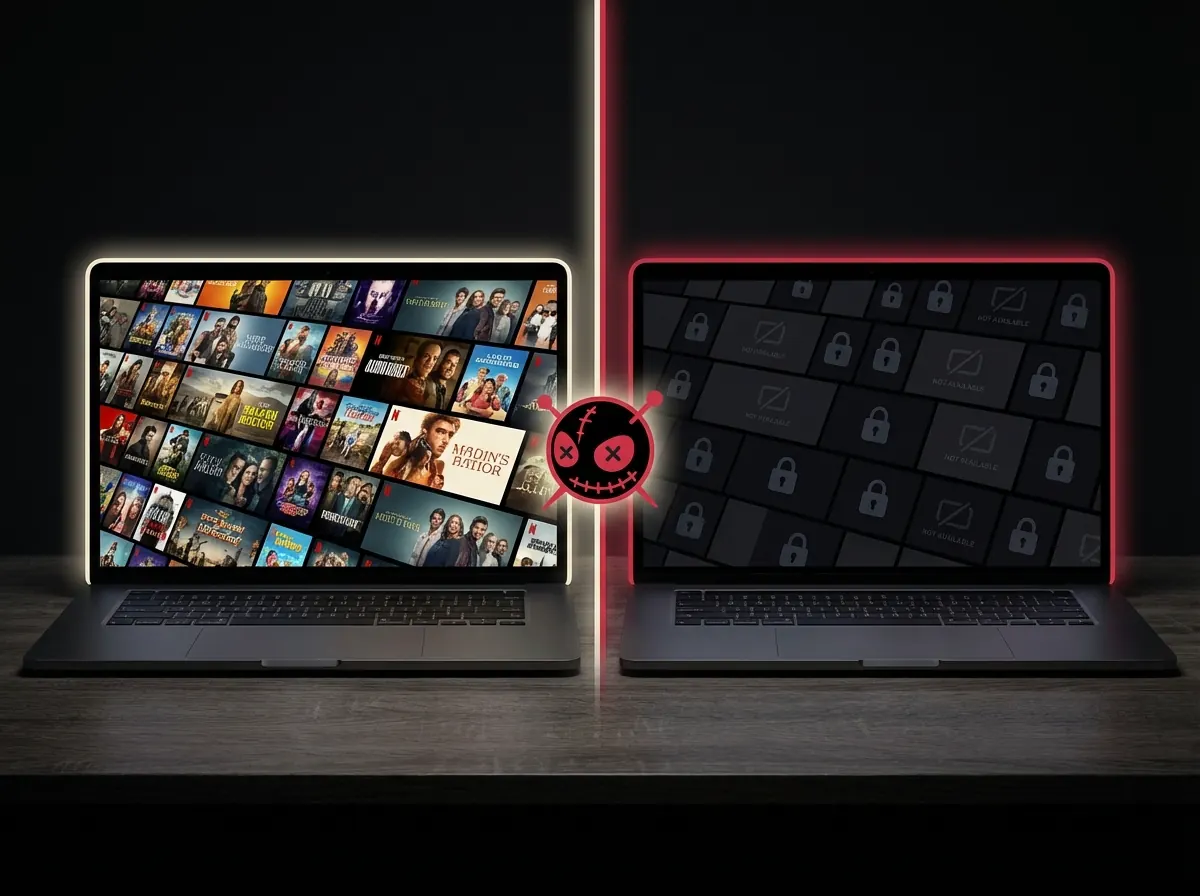
The show exists. It is on Netflix. You are paying for Netflix. You open Netflix. The show is not there.
Not because it was removed. Not because it is still in production. Not because of a technical glitch. The show is not there because you are in the wrong country. Or the wrong state. Or on the wrong side of an invisible line drawn by a licensing contract you will never see.
You are paying full price for a partial library. And the streaming platforms are not even pretending otherwise.
Two Countries. Same Price. Different Libraries.
Netflix charges roughly the same subscription fee everywhere. In the U.S., the Standard plan runs $15.49/month. In the UK, it is £10.99 (about $14). Same price range. Radically different libraries.
Netflix Library Comparison: US vs. UK
United States
- Largest Netflix library globally
- Thousands of titles
- Exclusive U.S. originals at launch
- Full back catalog of licensed content
United Kingdom
- Hundreds fewer titles than U.S.
- Missing major licensed films
- Different original release windows
- Some content exclusive to UK competitors
Japan has content unavailable anywhere else. Turkey gets different pricing and different titles. India has Bollywood exclusives that vanish the moment you cross the border. Canada gets a different catalog entirely.
You are not subscribing to Netflix. You are subscribing to your region's Netflix. And no one tells you that at checkout.
BBC iPlayer: A Masterclass in Geo-Blocking
If Netflix's geo-restrictions are frustrating, BBC iPlayer is a wall. iPlayer is completely unavailable outside the United Kingdom. Not partially. Completely.
"BBC iPlayer only works in the UK. Sorry, it's due to rights issues."
That is the message you see if you try to access iPlayer from the United States, Europe, Asia, or anywhere else. The BBC produces some of the most acclaimed television in the world: Doctor Who, Sherlock, Planet Earth, Peaky Blinders before it moved to Netflix. And if you are not physically in Britain, you cannot watch any of it on the platform it was made for.
British citizens traveling abroad lose access to the service their taxes fund. American fans who want to watch BBC content legally have no option. The content exists. The platform exists. The technology exists. But an invisible border blocks you.
Why Your Library Is Missing Half Its Shelves
Content licensing is sold territory by territory. A studio that produces a film will sell distribution rights to Netflix for the U.S., to a local broadcaster in Germany, to a cable operator in Japan, and to a streaming competitor in Australia. Each deal is separate. Each territory is carved up independently.
The result is a patchwork of availability that makes no sense to anyone who is actually trying to watch something:
- A film available on Netflix US might be on Amazon Prime in the UK, on a cable channel in France, and on a completely different streaming service in Brazil.
- A show you started watching while traveling in one country can vanish from your library the moment you return home.
- Disney+ originals are available globally, but licensed content on Disney+ varies by region. The same platform, same subscription, different content.
- HBO Max (now Max) is not available in many countries at all. International viewers simply cannot subscribe.
You are not the customer in these deals. You are the product of the territory. Your viewing rights are determined by which distributor outbid the others for your geographic rectangle.
You Travel. Your Library Does Not.
This is not just an annoyance for people who want foreign content. It hits anyone who crosses a border.
Business travelers who fly to London for a week lose access to their U.S. Netflix library. The shows they were midway through disappear. Their watchlist changes. Their recommendations reset.
Students studying abroad lose their home streaming libraries for months or years. A semester in Spain means no access to U.S. Hulu, no Peacock, and a completely different Netflix catalog.
Expats pay for subscriptions they cannot fully use. Americans living in the UK, Brits living in the U.S., anyone who has moved countries knows the frustration of paying for a service and receiving a fraction of its actual value.
EU regulations attempted to fix this within Europe with the Portability Regulation, which requires streaming services to let EU subscribers access their home library while traveling within the EU. It was a start. But it only applies within the EU, it only applies temporarily, and it does nothing for anyone traveling to or from the rest of the world.
The VPN Crackdown Is Real
VPNs were the obvious solution for years. Connect to a VPN server in the U.S. to get the U.S. library. Connect to a UK server for BBC iPlayer. Simple, effective, and widely used.
Streaming services declared war on VPNs around 2016, and they have been escalating ever since. Netflix actively blocks known VPN IP addresses. BBC iPlayer runs advanced VPN detection on every connection. Disney+, Amazon Prime, and Hulu all maintain blocklists that are updated constantly.
The result: even premium VPN services that advertise "works with Netflix" often fail. Connections get blocked mid-stream. Specific servers work one day and fail the next. The experience is a constant game of cat-and-mouse that the streaming services are winning.
And now governments are joining in. The CISA has warned against personal VPN use. UK officials have called VPNs "a loophole that needs closing." The tool that millions used to access their own paid content is being systematically dismantled.
Check the route. Check the rights.
Legba is a Chrome extension with two modes. Ghost gives the browser a private route. Shield opens a page in an isolated browser off the device.
A route can change which regional page a service shows. It does not change your subscription, account region, payment method, current rights package, or the service's terms.
Two different browser jobs
Ghost
- Changes the browser route
- Leaves other apps unchanged
- Does not promise a new fingerprint
Shield
- Opens the page off the device
- Destroys the isolated session on close
- Does not guarantee streaming access
Streaming services can use network, account, device, and payment signals. Legba does not claim a clean fingerprint, undetectable access, or compatibility with every service.
Use the mode that matches the job
Legba installs as a Chrome extension. Use Ghost when the browser route is the variable. Use Shield when the page should run off the device.
Then verify the service's rights, account rules, playback support, and terms. A different route is not a promise that a title will play.
A different route does not change the license
Regional libraries remain a licensing decision. Legba can change a browser route or page execution boundary. It does not change the rights attached to an account.
Keep exploring access
Related reading on geo-restrictions, VPN limits, and isolated browsing.
You Paid for the Stream and Still Hit a Blackout Screen. That's the Scam.
Sports blackouts and fragmented rights still leave paying fans without a game. See why the model fails in 2026 and what to check next.
Browser isolation vs VPN: which tool fits in 2026?
VPNs protect a network path. Browser isolation changes where web content runs. Compare their scope, limits, and best uses.
The VPN Ban Is Coming: Here's What You Stand to Lose
1.8 billion people rely on VPNs daily. Now governments want them gone. Here's what that means for your streaming, travel, privacy, and freedom.
Free for 30 days. No card required.
Choose the browser boundary
Legba is a Chrome extension with two modes. Ghost gives you a private browser route. Shield opens a page in an isolated browser off your device.
